What is a Multi-Broker Copy Trading Platform?
A multi-broker copy trading platform is an advanced financial software ecosystem that allows retail traders, signal providers, and institutional investors to mirror live trading positions across completely different brokerages, liquidity providers, and trading terminals. Unlike traditional proprietary social trading networks that force both the master trader and the follower to use the exact same broker, a modern multi-broker copy trading platform bridges disparate technological infrastructures—such as MetaTrader 4, MetaTrader 5, cTrader, and TradingView webhooks—into a unified execution pipeline.
By decoupling signal generation from trade execution, these platforms empower users to maintain their preferred broker relationships, leverage unique leverage tiers, and secure optimal regional regulation while simultaneously participating in decentralized social trading networks. Whether you are seeking to explore verified copy trading dashboards or automating your portfolio using algorithmic strategies found in our trading EA downloads directory, understanding how these underlying systems communicate is paramount to achieving slippage-free execution.
Key Takeaway: A true multi-broker copy trading platform eliminates broker lock-in, enabling seamless order replication across distinct technological architectures, liquidity pools, and regulatory jurisdictions without compromising trade latency.
How External Account Connection Works (Master & Follower Setup)
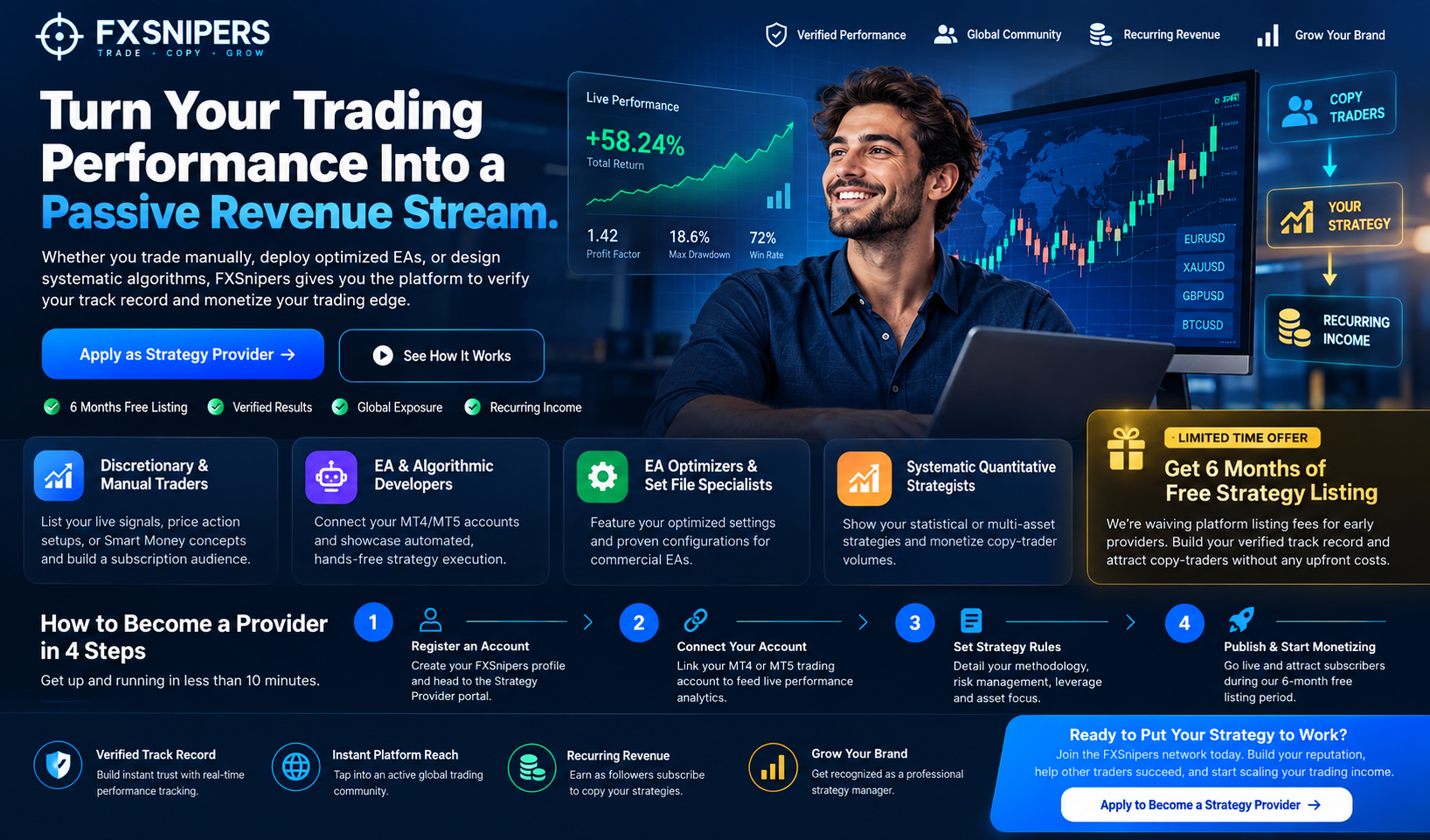
Establishing a secure and resilient connection between external trading accounts and a central copy trading platform requires authenticating account credentials via industry-standard protocols. The setup process bifurcates into two distinct roles: the Master account, which acts as the singular source of trade signals, and the Follower accounts, which ingest those signals and replicate positions according to predefined risk parameters.
The connection pipeline typically utilizes broker-issued API keys, read-only investor passwords, or lightweight bridge applications installed directly on the user's Virtual Private Server (VPS). Once authenticated, the platform continuously polls or listens via WebSockets for state changes on the master account, capturing order creation, modification, and closure events in real time before dispatching them to the follower execution queues.
Core Platform Architecture: Cloud Middleware vs. Custom EAs
Modern copy trading solutions generally rely on one of two architectural models to transmit trade data: cloud-based middleware or client-side Expert Advisors (EAs). Each architecture presents distinct trade-offs regarding latency, infrastructure costs, and reliability.
- Cloud Middleware Architecture:
Operates entirely on centralized cloud servers. Master and follower accounts connect via API tokens. This method requires zero terminal installations on local computers, making it ideal for web-based applications and multi-terminal management.
- Custom EA Client Architecture:
Relies on local MetaTrader terminal plugins that communicate directly with a central database via HTTP requests or TCP sockets. This approach is favored by ultra-low-latency scalpers who host their setups on institutional collocated VPS infrastructure.
- Hybrid Models:
Combine cloud-based dashboard controls with lightweight client-side execution daemons to ensure maximum uptime even during broker API maintenance windows.
How Master Traders & Signal Providers Connect Accounts
For a master trader or signal provider, setting up an account on a copy trading platform focuses heavily on transparency, performance tracking, and security. Signal providers must register their trading account by supplying broker server details and master credentials, enabling the platform's auditing engine to verify historical trade performance, win rates, maximum drawdown, and profit factors.
Once verified, the provider's account is indexed into the platform's public or private marketplace. Every time the provider executes an order—whether manually or via automated custom MQL coder quotes and custom algorithms—the platform's event listener logs the exact ticket parameters, including asset class, entry price, volume, stop loss, and take profit levels, broadcasting them instantly to subscribed followers.
How Followers/Copiers Connect Accounts & Select Signal Providers
Followers participate in the ecosystem by linking their broker trading accounts to the platform and allocating specific capital pools to chosen signal providers. The onboarding workflow is designed to be frictionless, requiring only the broker name, server designation, account login number, and password.
After successful authentication, users navigate performance analytics dashboards to evaluate signal providers based on risk-adjusted metrics like the Sharpe ratio, recovery factor, and historical asset correlation. Followers retain complete sovereign control over their funds; they can adjust risk allocation multipliers, pause copying during high-impact macroeconomic news releases, or instantly terminate a subscription and manually close mirrored positions at any given moment.
Real-Time Trade Execution: How Trades Are Copied Across Brokers
The journey of a copied trade from a master account to a follower account occurs in milliseconds. When a master account executes an order, the platform's server captures the transaction event, normalizes the data structure, and routes it through an intelligent execution queue.
To maintain integrity across disparate broker liquidity pools, the platform accounts for variable network latencies and broker-specific execution speeds. Advanced systems utilize asynchronous threading and multi-region server distribution to ensure that follower orders are submitted concurrently, minimizing the risk of front-running or excessive slippage during high-volatility market events such as the London-New York overlap or central bank rate announcements.
Lot Sizing Engine: Proportional Equity, Fixed Lots, & Risk Scaling
One of the most critical components of any professional copy trading platform is its lot sizing engine. Because master accounts and follower accounts rarely share identical account balances or leverage limits, naive volume replication would quickly wipe out smaller accounts or under-utilize larger ones.
- Proportional Equity Sizing:
Automatically scales trade volume based on the ratio between the follower’s account equity and the master's account equity. If a master with $10,000 risks 1 lot and a follower has $5,000, the trade is scaled down to 0.5 lots.
- Fixed Lot Sizing:
Executes a predefined, constant lot size on every copied trade regardless of the master's volume or account size, ideal for strict risk management models.
- Multiplier & Risk Scaling:
Allows users to apply a custom multiplier (e.g., 0.5x, 2x) over proportional calculations to deliberately amplify or diminish risk exposure relative to their personal financial goals.
Managing Symbol Differences & Cross-Broker Price Mapping
Brokerages frequently utilize varying nomenclature and ticker suffixes for identical financial instruments—for instance, EURUSD versus EURUSD.pro, EURUSDm, or EURUSD.ecn. A robust copy trading platform incorporates sophisticated symbol mapping dictionaries to resolve these discrepancies automatically.
Beyond asset naming conventions, cross-broker price mapping addresses variations in contract specifications, such as contract sizes for indices (e.g., US30 vs. WallStreet vs. DJI) or commodity lot increments. The translation engine normalizes these variables instantly, ensuring that a micro-lot position in a master account maps correctly to the precise equivalent value on the follower's specific broker feed.
Monetization & Performance Fees: High-Water Mark & Subscriptions
Signal providers require robust monetization mechanics to incentivize ongoing strategy development and transparent risk management. Professional platforms support flexible compensation models that protect both parties and align financial incentives.
- High-Water Mark (HWM) Performance Fees:
Providers earn a predetermined percentage (e.g., 20%) of the net new profits generated in the follower's account. Fees are only calculated when equity surpasses the previous peak, safeguarding followers from paying twice for recovering losses.
- Flat Subscription Fees:
Followers pay a fixed monthly recurring fee to access specific signal provider channels, regardless of trading volume or net profitability.
- Volume-Based Rebates (CPA/RevShare):
Integrated affiliate structures that reward introducing brokers and signal providers based on trading activity generated across connected liquidity networks.
Signal Provider Terms & Conditions
To maintain marketplace integrity, protect copiers, and establish clear operational boundaries, all Signal Providers ("Providers") listed on the multi-broker platform must adhere to strict contractual obligations and performance guidelines.
- Verification & Auditing:
Providers must supply read-only credentials or API keys to live trading accounts with a minimum required operating history. Demo accounts, simulated track records, or unverified metrics are strictly barred from public listing.
- Prohibited Trading Behaviors:
Intentional exploitation of latency gaps, abusive martingale grid expansion without defined stop losses, and artificial volume pumping are grounds for immediate delisting and forfeiture of accrued performance allocations.
- Execution Disclaimer & Non-Fiduciary Status:
Providers operate as independent signal publishers and do not hold or manage investor capital directly. Signal providers assume no liability for execution variances, spread widenings, or slippage incurred across external follower brokerages.
Escrow Payment Protection Mechanism
To ensure financial safety and foster trust between signal providers and copiers, subscription revenues and performance fee allocations are managed through an automated financial escrow framework.
Under the Escrow Payment Agreement, all copier subscription fees and high-water mark performance distributions are locked in a segregated holding vault for a standard 14-day settlement window (or until the end of the monthly billing cycle). During this window, automated auditing daemons perform the following checks prior to releasing funds to the provider's payout wallet:
- High-Water Mark Verification:
Confirms that calculated performance fees correspond accurately to net positive account equity beyond previous maximum profit peaks.
- Signal Service Continuity Audit:
Ensures the master account maintained active WebSocket connection status and fulfilled the minimum agreed signal publication quota without unexpected technical abandonments.
- Pro-Rata Refund Safeguards:
In the event of catastrophic master account failure or breach of agreed strategy risk parameters, copiers receive pro-rata escrow refunds for the unexpired portion of their active subscription billing period.
Automated Risk Management: Stop Loss, Max Slippage, & Drawdown Limits
Protecting capital in decentralized trading environments demands multi-layered automated risk controls built directly into the copy trading platform's core architecture. Users can configure safety thresholds that act as circuit breakers during unexpected market shocks.
Essential risk settings include maximum allowable slippage limits—which cancel order execution if the price drifts beyond a specified pip threshold—as well as hard account-level drawdown cutoffs. If a follower's account experiences a cumulative daily or total drawdown exceeding the pre-set percentage, the platform automatically detaches the account from all signal providers, liquidates open exposure, and preserves remaining capital.
Platform Security: How Read-Only Credentials Protect Client Funds
Security is the foundational pillar of any reputable copy trading platform. Clients must never be required to surrender master passwords or direct custody of their funds to third-party software vendors. Funds remain safely segregated inside regulated broker bank accounts.
To interface with trading terminals, platforms utilize secure API tokens or Investor (Read-Only) passwords combined with authorized trade execution gateways. This architectural separation ensures that even in the unlikely event of a security breach on the middleware server, malicious actors cannot initiate unauthorized withdrawals, internal transfers, or deposit modifications on the user's brokerage account.
Multi-Broker Compatibility: Connecting MT4, MT5, cTrader, & TradingView
The true measure of an advanced copy trading platform is its universal terminal compatibility. Modern retail traders utilize a diverse array of charting software and execution environments, necessitating robust protocol adapters.
- MetaTrader 4 & MetaTrader 5 (MT4/MT5):
Deep integration via specialized terminal expert advisors and DLL libraries supporting both hedging and netting account modes across thousands of global brokers.
- cTrader:
Native API connectivity leveraging cTrader Open API protocols for lightning-fast execution and level II pricing depth.
- TradingView Webhooks:
Instantaneous parsing of Pine Script alert json payloads, allowing strategy creators to broadcast automated signals directly from charts to multi-broker copy networks.
Step-by-Step: Setting Up Your Account on the Trade Copier Engine
Deploying your first automated replication pipeline requires following a structured, secure configuration workflow designed to ensure optimal trade matching and risk control.
- Step 1: Account Registration & Verification:
Create your user profile on the copy trading platform dashboard and complete standard security protocols including two-factor authentication (2FA).
- Step 2: Link Trading Terminals:
Input your broker account credentials, server name, and account type (Master or Follower) into the secure connection manager.
- Step 3: Configure Lot Sizing & Risk Parameters:
Choose between proportional, fixed, or multiplier sizing engines and set maximum drawdown thresholds and slippage filters.
- Step 4: Select Signal Providers & Activate:
Browse verified performance statistics, subscribe to your preferred strategy providers, and toggle the master switch to commence live, automated trade replication.