

AUD/USD vs. Silver (XAGUSD) Trading Comparison & Strategies
Evaluate specifications, win rates, drawdowns, and trading setups for AUD/USD and Silver (XAGUSD) side-by-side.
YouTube has become one of the largest sources of forex trading education. Traders can discover hundreds of strategies covering price action, liquidity, indicators, market structure and session-based setups.
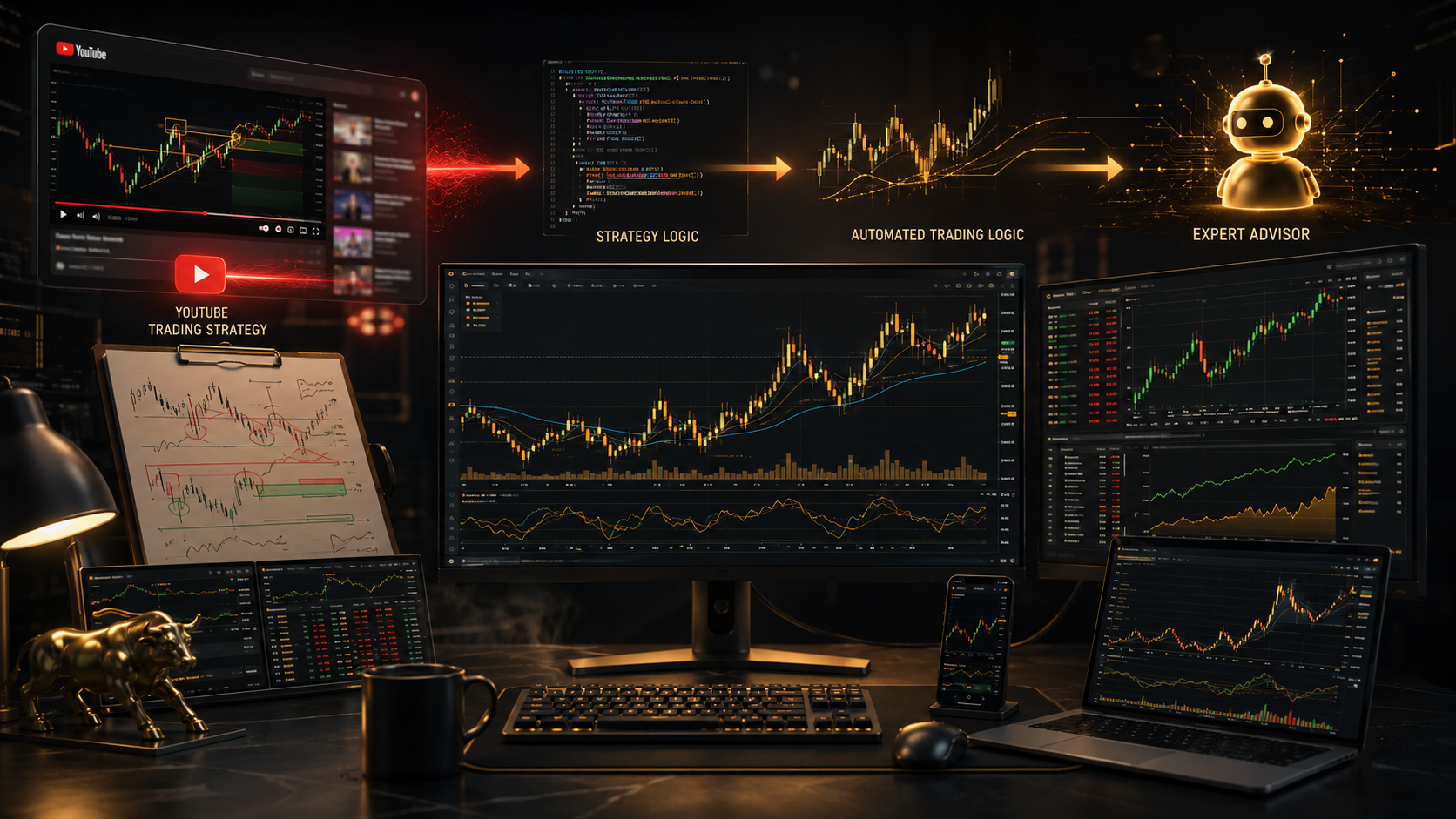
But watching a strategy is very different from testing it. The real challenge is turning a trading idea into clearly defined rules that can be measured, backtested and eventually automated.
YouTube provides traders with an enormous amount of free educational material. A single strategy video can explain a complete trading approach, demonstrate chart examples and show how the creator identifies potential entries and exits.
The problem is that many strategies are explained visually rather than mathematically. A trader may understand the idea while watching the video but struggle to consistently identify the same setup manually.
Before creating an Expert Advisor or TradingView script, the strategy must be converted from a visual explanation into a structured set of rules.
For example, a video might say that a trader waits for a liquidity sweep followed by a market structure shift. That concept needs to be translated into measurable conditions that software can understand.
Define exactly what needs to happen before an entry is allowed. This could involve indicators, price levels, candle patterns, market structure or trading sessions.
Specify take profit, stop loss, trailing logic, time-based exits or conditions that invalidate the original trade idea.
Position size, stop loss distance, maximum daily loss and the number of simultaneous trades should be defined before automation. Our risk management course walks through these principles in more depth.
Once the trading rules are clearly defined, the strategy can move through a structured development and testing process.
Review the strategy carefully and identify every condition that influences an entry, exit or risk decision.
Convert the strategy into a written rule set. Ambiguous phrases should be replaced with measurable conditions wherever possible.
The rules can then be implemented as an Expert Advisor for MetaTrader 5 so that the system can execute and test the strategy consistently. If you'd rather not build it yourself, our team offers custom EA development to turn your rule set into a working Expert Advisor.
The same logic can be implemented in Pine Script to visualize signals and evaluate the strategy within TradingView.
Run historical tests and compare results across different symbols, timeframes and market conditions.
An Expert Advisor allows a defined trading strategy to be executed consistently according to programmed rules. This removes many of the repetitive manual actions involved in searching for setups and managing trades. Browse our catalog of Expert Advisors to see fully built and tested examples.
An automated system follows the programmed conditions without changing its interpretation because of emotions or fatigue.
An EA can monitor conditions continuously and react when its predefined rules are satisfied.
A coded strategy can be tested against historical market data to understand how the rules behaved previously.
Once rules are properly defined, the system does not change its interpretation from one chart to another.
TradingView can be useful for visualizing strategy conditions and reviewing historical signals directly on price charts.
A Pine Script implementation can show entries, exits, indicators and other conditions directly on the chart, making it easier to understand whether the programmed logic matches the original strategy.
The MT5 EA can focus on automated execution and testing, while the TradingView implementation can provide a useful visual representation of the strategy logic.
After automation, the strategy should be tested using historical market data. Backtesting helps identify whether the programmed rules produce behaviour that resembles the original trading concept.
Measures the overall simulated result during the testing period.
Shows how deeply the simulated account declined from an equity peak.
Compares gross profits against gross losses.
Provides context for how much historical activity supports the results.
Shows the percentage of trades that closed profitably.
Helps evaluate whether the strategy risk is realistic for the expected losing periods.
Once a strategy is automated, developers may test different parameter combinations. This can help identify settings that perform reasonably well across historical data.
However, optimization must be approached carefully. If too many parameters are adjusted to achieve the best possible historical result, the strategy can become overfitted to the data.
Do not optimize for the most impressive historical result. Look for stable behaviour across different periods and market conditions.
A backtest is only one part of evaluating an automated trading strategy. Forward testing allows the system to operate using new market data that was not part of the historical development process.
Used to understand how the strategy behaved under previous market conditions.
Used to evaluate whether the system continues to behave as expected outside the historical testing sample.
Some strategies rely on discretionary decisions that are not clearly explained. Those decisions must be identified before automation.
A small sample can produce misleading results and should not be treated as proof that a strategy is robust.
Spread, commission and slippage can significantly influence the performance of short-term automated strategies.
A strategy that only works with a highly specific historical configuration may not be robust enough for future market conditions.
Historical results cannot guarantee future trading performance.
Before turning a YouTube trading strategy into an automated system, work through these questions.
Are every entry and exit condition clearly defined?
Are stop loss, position sizing and exposure rules defined?
Does the EA accurately represent the original strategy?
Can the strategy conditions be visualized and reviewed?
Has the strategy been tested across sufficient historical data?
Has the system been tested using new market data?
Trading strategies can come from many sources, including YouTube videos, trading communities, educational courses and personal research.
The important step is turning those ideas into measurable rules. Once the rules are defined, they can be implemented as an MT5 Expert Advisor, represented as a TradingView Pine Script strategy and evaluated using historical and forward testing.
At FXSnipers, the focus is on making trading strategies more systematic, testable and easier to evaluate rather than relying only on visual examples or subjective decisions. Explore our Expert Advisor catalog or read more on our trading blogs.
YouTube can be an excellent source of trading ideas, but a strategy shown in a video is not automatically a complete trading system.
The real value comes from converting the concept into clearly defined rules, implementing those rules consistently and testing how they behave across different market conditions.
Watch → Define → Automate → Backtest → Forward Test
An MT5 EA and TradingView strategy can make the evaluation process more systematic, but neither guarantees profitable future trading results. If you'd like help going from idea to a tested system, our custom EA development team can build and test it with you, or you can browse ready-made Expert Advisors in the meantime.
A YouTube strategy is only an idea until its rules are clearly defined. Automation turns those rules into something that can be measured and tested.
Define the rules. Test the logic. Understand the risk. Never confuse historical results with guaranteed future returns.
Algorithmic systems architect and quantitative developer at FXSnipers. Specializes in MQL5 strategy automation, MT5 tick data modeling, and mathematical risk management systems.
Automate your strategies with these fully backtested expert advisors matching this article's topics.
An adaptive auction-driven EA that reads live tick order flow to classify the market as TRENDING or RANGING, then deploys three coordinated roles — SWORD, SPIKE, and GHOST — to attack, recover, and extend positions with full daily profit-lock and drawdown protection.
The Rizwan Nawaz is a dedicated group of professional traders and quantitative developers. With years of experience building high-performance Expert Advisors, automated systems, and robust risk management strategies for MT4 and MT5, they share deep market insights to help retail traders automate their success.
Explore complementary algorithmic guides, EA setups, and market strategies from our verified authors.
Evaluate specifications, win rates, drawdowns, and trading setups for AUD/USD and Silver (XAGUSD) side-by-side.
A deep quantitative performance audit examining how raw spreads, turnover commissions, and execution slippage dictate net Sharpe ratios and profit factors for high-frequency algorithmic trading systems.
Retail algorithmic traders routinely watch months of steady gains vanish in seconds during major macroeconomic releases. Learn the quantitative pitfalls of trading through high-impact events like CPI and NFP, and master the technical implementation of latency-resilient automated news filters.
Evaluate specifications, win rates, drawdowns, and trading setups for GER30 (DAX) and Silver (XAGUSD) side-by-side.
Master the quantitative dynamics of crypto liquidation hunting. Discover how institutional desks track high-leverage debt overhangs on Bitcoin and Ethereum to engineer high-probability mean-reversion entries.
Relying on a master trader's stop-loss is the fastest route to account liquidation. Discover how to architect, calibrate, and execute client-side emergency stop-outs and hard equity drawdowns directly at the copier level.
An analytical deep-dive into managed portfolio transparency, exploring real-time ledger accounting, profit-share settlement cycles, and investor protection standards to safeguard capital against hidden operational risks.
Reach over 25,000+ active traders and quants. Get verified author bylines, do-follow exposure, and build direct industry authority in automated trading.
Download the complete quantitative guide: Position Sizing Formulas, Prop Firm Drawdown Rules, and MQL5 Parameter Cheat Sheets.