


Gold (XAUUSD) vs. Ripple (XRP) Trading Comparison & Strategies
Evaluate specifications, win rates, drawdowns, and trading setups for Gold (XAUUSD) and Ripple (XRP) side-by-side.
Unpack the core architectural differences between MetaTrader 4 and MetaTrader 5. Learn how 99.9% real-tick modeling, 64-bit multi-threaded execution, and ultra-low latency VPS colocation eliminate execution drag and protect live algorithmic performance.
In high-frequency algorithmic trading, platform architecture dictates whether your execution logic survives live market friction or crumbles under order queue delays. MetaTrader 4 (MT4) was released in 2005 as a 32-bit, single-threaded application limited to a strict 4GB RAM ceiling. Every tick update, indicator calculation, and order execution occurs sequentially on a single thread. When high-volatility events trigger dozens of price changes per second, MT4's thread blocks, creating processing latency before your trade request even leaves your virtual machine.
MetaTrader 5 (MT5), conversely, features a modern 64-bit, multi-threaded architecture with asymmetrical memory handling. It decouples the user interface thread, price incoming pipeline, and order execution routing. Furthermore, MT5 provides true asynchronous trading functions (OrderSendAsync()), enabling Expert Advisors (EAs) to fire multiple execution requests simultaneously without waiting for broker server confirmations.
Architectural Takeaway: MT4 processes orders sequentially in a single queue, causing bottlenecks during news events. MT5 routes orders asynchronously across multi-core CPUs, reducing client-side terminal processing delay from ~15ms down to microsecond thresholds.
If you are deploying high-frequency strategies or multi-pair systems available in our automated Expert Advisors index, understanding these memory and thread bottlenecks is the first step toward eliminating structural execution losses.
Backtesting accuracy depends entirely on data fidelity. MT4 native backtesting utilizes interpolated 'Control Points' (generating synthetic ticks between M1 bar OHLC values) or fixed spread assumptions. This yields a maximum modeling quality of 90% or open-price bar estimation. While backtesting on Open Prices executes rapidly, it introduces massive visual distortion by ignoring intra-bar spread widening, slippage, and stop-loss hunting behavior.
MT5 revolutionizes strategy validation by integrating 99.9% real-tick modeling quality natively with precise, floating Bid and Ask prices stored per millisecond. This distinction is critical for scalping and breakout strategies where equity curves diverge sharply between backtests and live markets.
"An Expert Advisor backtested on Open Prices or simulated 90% MT4 data is blind to variable spread spikes. It models phantom profits that disintegrate under real exchange execution."
Consider the mathematical breakdown of open-price backtesting vs. real-tick data over 1,000 backtested trades on EURUSD during London market open:
MT4 Open Price Model (Simulated)
MT5 99.9% Real-Tick Model (Variable)
The false sense of security provided by MT4's open price backtests leads traders to over-leverage EAs that are mathematically guaranteed to fail live. MT5's real-tick engine eliminates this survivorship bias.
Execution speed in modern automated trading is governed by the physical distance between your algorithm's host server and your broker's matching engine. Running an Expert Advisor on a standard home connection results in round-trip ping times of 50ms to 150ms. In volatile conditions, a 100ms latency window is enough for price quotes to move 2 to 5 pips away from your entry price.
To achieve institutional execution, you must deploy your MT4 or MT5 terminals on a specialized Virtual Private Server (VPS) collocated in key financial data centers, such as Equinix LD4 (London), NY4 (New York), or TY3 (Tokyo).
Three Rules for Ultra-Low Latency Setup:
TCP_NODELAY) on the VPS OS to prevent small data packets from buffering prior to transmission.When upgrading system code or transitioning custom indicators, utilizing professional custom MQL5 coding services ensures that structural latency optimization is built directly into the algorithm's backend thread routines.
Slippage is the difference between the price at which your EA requests an order and the price at which the trade is executed by the liquidity provider (LP). Mathematically, slippage cost per trade is expressed as:
Cost_Slippage = (Fill_Price - Executed_Price) * Lot_Size * Contract_Size
While MT4 primarily supports basic Instant and Market execution types, MT5 introduces granular execution modes and order filling policies that actively prevent slippage drag:
Dynamic ATR Slippage Filter Rule: In MQL5 code, calculate current 1-minute ATR (Average True Range). If current spread + dynamic slippage buffer exceeds 20% of M1 ATR, suppress trading commands until liquidity stabilizes.
To help retail traders and developers systematically transition from legacy setups to robust MT5 algorithmic engines, follow this execution protocol checklist:
OnTick(), OnTradeTransaction()).MT4 backtests frequently use static spread inputs and interpolated tick sequences (Control Points), hiding real-world slippage and spread expansion. Live MT5 environments execute against dynamic order books and floating Bid/Ask spreads, exposing system vulnerabilities that were hidden during flawed MT4 backtesting.
No. Lower latency reduces client-to-broker transit time. However, slippage can still occur on the broker's side if liquidity at your target price is exhausted. Utilizing MT5 order filling policies like FOK (Fill or Kill) and limit orders protects against broker-level execution slippage.
Automate your strategies with these fully backtested expert advisors matching this article's topics.
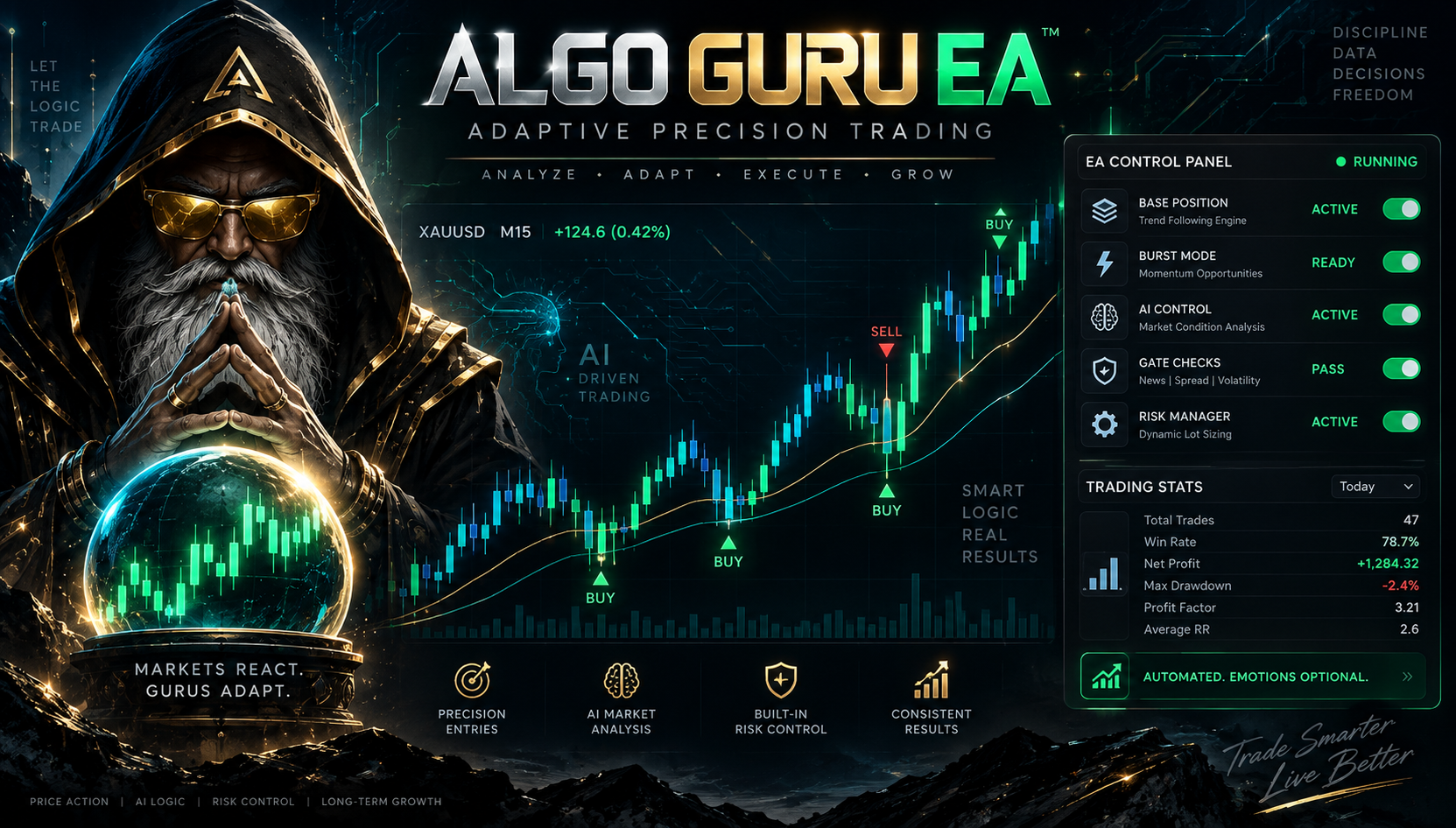
An adaptive auction-driven EA that reads live tick order flow to classify the market as TRENDING or RANGING, then deploys three coordinated roles — SWORD, SPIKE, and GHOST — to attack, recover, and extend positions with full daily profit-lock and drawdown protection.
The FXSnipers Team is a dedicated group of professional traders and quantitative developers. With years of experience building high-performance Expert Advisors, automated systems, and robust risk management strategies for MT4 and MT5, they share deep market insights to help retail traders automate their success.
Loading activity...
Just now