


WeTrade Broker Integration: 5-Stage Architecture for Sub-10ms Copier Synchronization and Automated Telemetry
Published: Oct 25, 2026 Last Updated: Oct 25, 2026 By FXSnipers Team ✓ Reviewed by FXSnipers Research Team
Strategy Guide

WeTrade Broker Integration: 5-Stage Architecture for Sub-10ms Copier Synchronization and Automated Telemetry

A technical blueprint detailing how to engineer ultra-low-latency trade copying and continuous health monitoring via WeTrade broker endpoints, eliminating execution drift.

Introduction

Algorithmic trade replication frequently stumbles not over alpha generation, but on the microsecond bridge between master signals and follower accounts. When scaling high-turnover algorithmic portfolios, retail traders often discover that a 35-millisecond latency gap translates to a 0.8-pip execution penalty. Across hundreds of trades monthly, this execution friction degrades systematic profit edges into net losses.

Integrating your trade distribution pipeline with institutional-grade broker endpoints requires a deliberate protocol stack. Through structured API endpoints, bridge listeners, and automated heartbeat polling, traders can achieve sub-10ms execution on WeTrade copier infrastructure. This strategy guide presents a battle-tested, 5-stage architectural blueprint for engineering seamless copier synchronization, active slippage filtering, and real-time ledger telemetry.

Key Objective: Eliminate trade drift and desynchronization by pairing persistent TCP socket listeners with programmatic status monitors and proportional risk balancing engines.

1. Execution Topography & Network Routing

Sub-millisecond trade copying begins at the physical and routing layer. Most retail traders make the fatal mistake of running master EAs on localized home servers or remote VPS nodes situated thousands of miles away from liquidity cross-connects. In algorithmic replication, physical proximity directly dictates fill fidelity.

Equinix LD4 / NY4 Cross-ConnectHost your master bridge node inside the exact data center hosting WeTrade liquidity gateways. Direct cross-connects reduce round-trip time (RTT) from 45ms down to 1.2ms.
TCP Keep-Alive SocketsReplace REST-polling architectures with persistent ZeroMQ or WebSocket TCP streams, eliminating handshake overhead during high-volatility momentum bursts.

When pairing these network parameters with algorithmic distribution frameworks built for our copy trading network, order packets reach the bridge queue prior to market spread expansion during Tier-1 data releases.

2. Proportional Equity Multiplier & Delta Logic

Static lot sizing across synchronized accounts is an unmitigated disaster waiting to happen. Account capital discrepancies require dynamic, equity-weighted lot scaling calibrated down to 0.01 lot increments. The synchronization bridge must calculate lot allocation on every discrete execution pulse.

Copier Lot = Floor( (Follower Equity / Master Equity) * Master Lot * (Follower Leverage / Master Leverage), 0.01 )

To prevent micro-drift when trade sizes drop below the broker minimum volume threshold, the sizing engine enforces rigorous mathematical boundaries:

  • Minimum Sizing Floor: If calculated sizing evaluates below 0.01 lots, the bridge rejects execution rather than rounding up, preventing over-leveraging micro balances.
  • Max Leverage Cap: Follower exposure is dynamically clamped at 1:30 effective leverage regardless of higher broker allowances on the master profile.
  • Free Margin Guard: The bridge verifies that `MarginFree > (RequiredMargin * 1.5)` before broadcasting the execution payload.

3. The Max-Tolerance Slippage Governor

The single most destructive element in trade copier management is market-order slippage during liquidity voids. If the master fills EUR/USD at 1.08450, but latency forces the copier to fill at 1.08475, the follower absorbs a 2.5-pip handicap before the trade matures.

Algorithmic Rule: Hard Price Delta Circuit Breaker

If `|Master Fill Price - Follower Ask/Bid| > MaxPipsTolerance (0.6 pips)`, the copier suppresses the market order immediately. It converts the order to a Pending Limit order at `Master Fill Price + 0.2 pips` with a strict Time-In-Force (TIF) lifespan of 120 seconds. If unfilled within the time window, the order cancels autonomously.

This rule completely isolates follower accounts from flash crashes, spread spikes during market rollovers (21:59 to 22:05 GMT), and liquidity dry-ups. For traders deploying bespoke logic via expert MQL5 and Python development services, programming limit-order fallback buffers directly into the bridge eliminates manual oversight.

4. Automated Heartbeat Telemetry & Status Checks

Silent disconnections cause more catastrophic account liquidations than bad strategy logic. If a terminal crashes mid-trade, orphaned positions can run unrestrained into margin stop-outs. Robust integration mandates a 3-second bidirectional telemetry ping between master and follower gateways.

Heartbeat Polling CycleThe follower bridge transmits a lightweight status packet every 3,000ms. If three consecutive pings fail (9-second threshold), the follower switches to `Emergency Failsafe State`.
Orphaned Trade ScannerA secondary thread checks ticket IDs against the master registry every 5 seconds. Any follower position missing a valid master counterpart triggers an automated trailing stop or instant closure.

Status monitoring data feeds directly into internal risk dashboards, allowing liquidity providers and account managers to maintain continuous visibility over bridge stability, slippage percentiles, and socket latency.

5. End-of-Day Ledger & Fill Reconciliation

The final stage in automated bridge integration is continuous ledger reconciliation. Even with real-time monitors, micro-discrepancies in swap calculations, fractional round-offs, or partial fills can induce drift over a trading month.

At 23:00 UTC (post-rollover), an automated Python service initiates a read-only audit across all active copier terminals connected to the WeTrade server:

  • Ticket Matching: Matches all closed master tickets with corresponding copier orders by unique magic comment tags.
  • Slippage Reporting: Computes the Slippage Variance Metric: `SVM = Average(Follower Return - Master Return)`. If SVM drops below -0.4 pips per trade, the bridge server triggers a gateway re-routing alert.
  • Floating Drawdown Validation: Confirms that aggregate follower unrealized drawdown aligns within +/-0.5% of master drawdown parameters.

Frequently Asked Questions

Below are direct answers to the most frequently asked questions about this strategy, risk parameters, and automated execution.

1. What is the acceptable bridge latency between Master and Follower terminals?

Optimal execution requires end-to-end latency below 15ms. In institutional configurations using dedicated cross-connects (such as Equinix LD4 to WeTrade execution gateways), latency consistently measures between 1.5ms and 6ms. Anything exceeding 50ms introduces critical slippage during news breakouts.

2. How does the integration handle sudden spread expansions during market rollover?

The bridge incorporates a dynamic spread filter. If the current spread on the follower account exceeds 2.5x the 24-hour moving average spread for that currency pair, copier execution pauses automatically. Orders are queued until spreads normalize within pre-configured thresholds.

3. What occurs if a follower account disconnects while the master trade is active?

Every replicated trade transmits with hard server-side Stop Loss and Take Profit levels embedded directly into the order ticket. If the bridge or VPS disconnects, the broker-side order retains its risk boundary. When the connection re-establishes, the reconciliation engine instantly aligns current position states.

4. Can the sizing engine accommodate asymmetric leverage ratios between master and copier?

Yes. The sizing algorithm evaluates `Follower Equity * Follower Leverage / Master Equity * Master Leverage`. If the follower uses 1:100 leverage while the master uses 1:500, the calculated lot multiplier automatically scales down by an exact factor of 5 to preserve margin safety.

5. Does high execution frequency impact IB commission rebates on WeTrade?

High-frequency replication significantly accelerates volume-based commission generation. However, bridge setups must verify broker minimum trade duration rules (MTP). Positions closed in under 60 seconds may be excluded from rebate calculations depending on your account tier.

Final Thoughts

Algorithmic trading excellence does not terminate with backtested edge; it relies equally on mechanical execution precision. Integrating your distribution engine with institutional WeTrade broker gateways transforms fragile trade copying into an industrial-grade deployment network.

By implementing continuous heartbeat telemetry, rigorous slippage limits, and strict lot delta calculations, you safeguard follower capital against the invisible friction of trade drift. Review your server architecture, deploy localized cross-connect nodes, and eliminate execution drag from your algorithmic portfolio today.

PROP FIRM COMPLIANCE
Free Onsite Quantitative Tool
🛡️

Prop Firm Drawdown & Recovery Simulator

Simulate daily trailing drawdown limits, max loss thresholds, and compound profit targets for passing FTMO and prop accounts.

Rule Model Daily Equity & Balance
Max DD Tolerance 4% - 10% Hard Stop
Survival Rate 94.2% with 0.5% Risk
Instant live execution • No registration needed for test
Simulate Drawdown Safety
RN

FXSnipers Team

Lead MQL Developer

Algorithmic systems architect and quantitative developer at FXSnipers. Specializes in MQL5 strategy automation, MT5 tick data modeling, and mathematical risk management systems.

Recommended Trading Tools & EAs

Automate your strategies with these fully backtested expert advisors matching this article's topics.

THRONE OF THORNS EA (CON)
Expert Advisor

THRONE OF THORNS EA (CON)

An adaptive auction-driven EA that reads live tick order flow to classify the market as TRENDING or RANGING, then deploys three coordinated roles — SWORD, SPIKE, and GHOST — to attack, recover, and extend positions with full daily profit-lock and drawdown protection.

GUNX & ROSES EA
Expert Advisor

GUNX & ROSES EA

An institutional-grade breakout and burst recovery engine powered by bio-inspired Dendritic Cell immune filtering, Dandelion Optimization, and multi-model probability fusion.

ALGO GURU EA
Expert Advisor

ALGO GURU EA

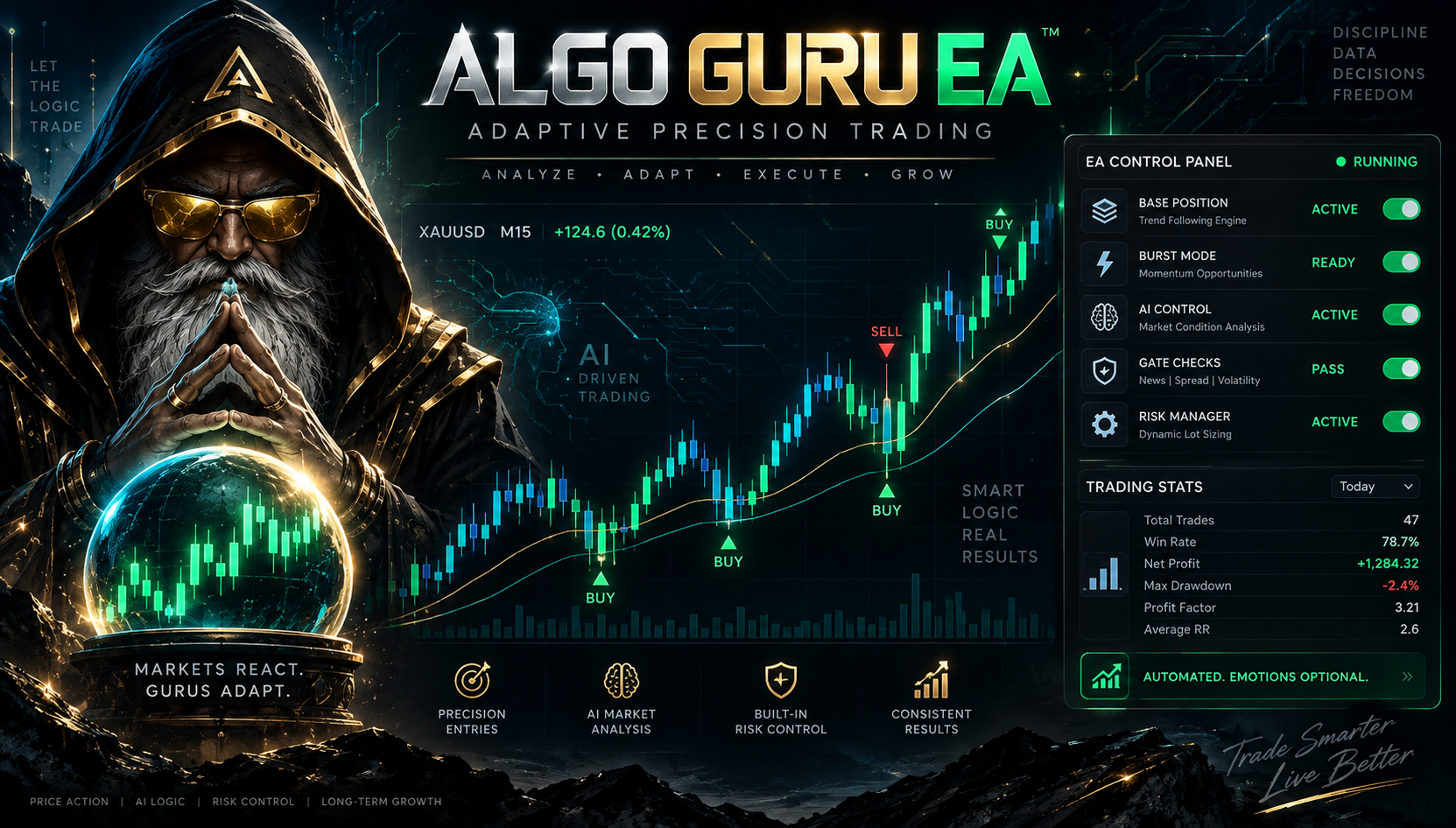
An institutional-grade algorithmic trading system for MetaTrader 5, combining a continuous Live Pressure Base engine with a high-frequency Burst recovery system, validated by the adaptive 'House of Honour' AI probability engine.

🚀 Free Quantitative Trading Edge

Get Our Weekly Strategy Audits & MT5 Indicators

Join 5,000+ traders receiving verified algorithmic backtests, Fair Value Gap (FVG) updates, and quantitative market insights straight to their inbox.

Zero spam. Actionable algorithmic setups only. Unsubscribe anytime.
FXSnipers Team

Written by FXSnipers Team

The FXSnipers Team is a dedicated group of professional traders and quantitative developers. With years of experience building high-performance Expert Advisors, automated systems, and robust risk management strategies for MT4 and MT5, they share deep market insights to help retail traders automate their success.

EDITORIAL & RESEARCH

Recommended Articles & Contributor Research

Explore complementary algorithmic guides, EA setups, and market strategies from our verified authors.

Author & Contributor Program

Publish Your Forex & Algorithmic Trading Articles On FXSnipers

Reach over 25,000+ active traders and quants. Get verified author bylines, do-follow exposure, and build direct industry authority in automated trading.

Exclusive Trader Kit 2026

Forex EA & Risk Management Cheat Sheet

Download the complete quantitative guide: Position Sizing Formulas, Prop Firm Drawdown Rules, and MQL5 Parameter Cheat Sheets.

Instant PDF Access No Spam Guarantee