


Sub-Millisecond Fill Architecture: Mitigating High-Impact News Slippage on WeTrade Infrastructure
Published: Oct 28, 2026 Last Updated: Oct 28, 2026 By FXSnipers Team ✓ Reviewed by FXSnipers Research Team
Setup Blueprint

Sub-Millisecond Fill Architecture: Mitigating High-Impact News Slippage on WeTrade Infrastructure

A deep dive into MT4/MT5 bridge latency, FIX API gateway topology, and order book mechanics during high-volatility news events. Learn how to configure slippage caps, optimize VPS cross-connects, and deploy asynchronous safety stops on WeTrade accounts.

Introduction

During major macroeconomic releases such as US Non-Farm Payrolls, FOMC rate announcements, and CPI releases, liquidity pools experience split-second vacuums. For algorithmic traders and multi-account managers deploying strategies on broker infrastructure like WeTrade, the difference between a pristine target entry and an account-draining order fill often comes down to sub-15ms execution delays. A profitable trading edge on backtests frequently degrades into a negative expectancy model in live conditions purely due to execution friction.

Execution quality is not a static broker specification; it is an active engineering problem encompassing network topology, MT4/MT5 execution queues, liquidity provider (LP) aggregation mechanics, and bridge configurations. When trading automated strategies from the free & premium Expert Advisors catalogue, understanding the mechanics of broker bridge throughput is essential to defending your capital against toxic market fills.

Key Objective: This blueprint establishes a practical engineering setup to measure, diagnose, and suppress negative slippage across WeTrade MT4/MT5 accounts by aligning VPS routing, bridge fill policies, dynamic slippage tolerances, and independent emergency circuit breakers.

Bridge Topology & Fill Dynamics

To address execution bottlenecks, one must first dismantle the transaction path from terminal to liquidity provider. When an Expert Advisor issues an OrderSend() request on a client terminal, the signal traverses several abstraction layers before an asset is filled.

1. Terminal-to-Server Latency

The physical fiber time required for packets to travel from your algorithmic execution server to the WeTrade trade matching engine. Measured via round-trip ping (RTT).

2. Bridge Processing Queues

Middleware engines (such as OneZero, PrimeXM, or proprietary bridges) that convert MetaTrader protocols into institutional FIX 4.4 messages for LP distribution.

3. LP Aggregator Sweeps

The bridge sweeps top-of-book quotes across multiple tier-1 banks and non-bank liquidity pools. In wide markets, book depth evaporates within 3 to 8 milliseconds.

4. Fill Confirmation Transmission

The matched ticket confirmation is passed backward through the bridge to update your terminal balance, margin requirement, and open position ticket.

During news shocks, top-of-book depth on EUR/USD can collapse from 50 million units to less than 1.5 million within 200 microseconds. If your bridge pipeline experiences 40ms of cumulative latency, your market order will bypass Tier-1 quotes and sweep lower into Tier-2 or Tier-3 order books, producing severe negative slippage.

'Slippage is not inherently an artificial broker tax; it is the mathematical cost of order queue delay across a thinning aggregate order book.'

Equinix Cross-Connect Optimization

The single most controllable factor in your execution chain is physical physical-layer proximity. Running execution engines or automated replication modules from a residential machine or generic commercial cloud (such as AWS us-east-1 or standard digital ocean droplets) introduces variable transit latencies ranging from 35ms to 140ms, rendering news-based automation unviable.

For WeTrade accounts, standard trading servers are typically collocated within prime financial data centers—most notably Equinix LD4 (Slough, London) or Equinix NY4 (Secaucus, New Jersey). Traders synchronizing high-volume strategies via the WeTrade copier dashboard & rebate tracking pipeline must align their host hardware directly inside these ecosystems.

  • Determine Target Data Center: Check terminal connection logs to identify the destination IP. A 1-2ms ping indicates collocation within the same data center cage; 15ms+ indicates cross-city transit.
  • Disable Network Throttling: On Windows Server instances, disable Nagle algorithm via registry modifications (TcpAckFrequency = 1, TCPNoDelay = 1) to ensure TCP packets fire without delay buffers.
  • Bypass DNS Resolution Overheads: Direct your terminal connection strings directly to static IP addresses rather than dynamic DNS hostnames to eliminate runtime domain lookups during server reconnections.

Parameter Tuning & Fill Policies

Configuring Expert Advisor inputs properly determines whether a trade safely fills or rejects cleanly when spreads flash-expand. In MQL4/MQL5, novice developers often default to broad execution tolerances, unwittingly allowing brokers to execute fills at outlier prices.

Crucial Rules for Parameter Calibration

  • Strict Slippage Bounds: Bound your deviation (or maximum slippage parameter) to a maximum of 1.5 to 2.5 pips during release hours. If the book moves beyond this boundary, an immediate ORDER_RETCODE_PRICE_OFF or requote rejection is preferred over a 12-pip adverse fill.
  • Fill-or-Kill (FOK) vs Immediate-or-Cancel (IOC): On MT5 accounts, utilize ORDER_FILLING_IOC. This instructs the liquidity bridge to fill whatever volume is available at the requested price or better, discarding unmatched size, rather than accepting partial fills across deteriorating tiers.
  • Spread Expansion Gates: Never fire market orders if (Ask - Bid) > (3.0 * Median_Spread_20MA). Programmatic filters must freeze execution 90 seconds prior to Tier-1 releases unless executing pure volatility-breakout straddles.

For traders managing multi-lot setups who require bespoke execution logic, leveraging custom Pine Script / MQL5 coding services ensures these specific low-level API controls are systematically integrated directly into your order routing routines.

Asynchronous Safety Stops & Telemetry

During severe liquidity blackouts, terminal-level safety stops may fail to execute if communication channels flood or broker order queues backlog. To protect aggregate account balance, experienced operations deploy asynchronous architectural circuit breakers that operate out-of-band.

Heartbeat Monitoring Daemon

A standalone background process querying the WeTrade account status via REST/Manager API every 2,500ms. If terminal response latency exceeds 400ms, alarms trigger to pause order transmissions.

Hard Account Equity Cutoff

An unmanaged local daemon operating independently from MetaTrader chart threads. If floating equity drops past a pre-set threshold (e.g., 4.5% drawdown in 60 seconds), it sends immediate bulk market liquidations directly via API.

Establishing automated telemetry allows operators to systematically monitor real-time execution slip: recording the exact timestamp of order creation, terminal transmission, bridge reception, and ticket open price. Any persistent divergence between recorded slip and expected theoretical backtest yields actionable data for route optimization.

Frequently Asked Questions

Below are direct answers to the most frequently asked questions about this strategy, risk parameters, and automated execution.

1. What is the maximum acceptable latency for high-impact news trading on WeTrade?

For news trading or high-frequency automated strategies, terminal-to-server round-trip latency must ideally stay below 2 milliseconds, and absolutely under 10 milliseconds. Any ping exceeding 25ms will invariably result in secondary or tertiary price tier fills during high-impact spikes such as US CPI or NFP.

2. Is MT4 or MT5 superior for reducing execution bridge latency?

MT5 is architecturally superior. MT4 operates on a synchronous execution pipeline where incoming commands can block worker threads. MT5 supports asynchronous order dispatching, multi-threaded historical processing, native execution type selection (IOC, FOK, RETURN), and millisecond-level time resolution on ticks, drastically reducing bridge queue delays.

3. How can I verify the exact slippage my account experiences per trade?

In your EA order send event, capture the current Ask/Bid quote into a variable right before calling OrderSend(). Once the order is returned with a ticket, compute the delta between your snapshot price and the returned open price (OpenPrice - SentPrice). Log this differential in points directly to a local CSV file for systematic post-trade execution auditing.

4. Does positive slippage exist, or is all slippage inherently negative?

On genuine ECN/STP setups with symmetric LP routing, positive slippage occurs frequently when price snaps favorably during transit. If an account consistently logs negative slippage on fast moves but never records positive fills on reversals, it indicates asymmetric broker markup or one-way execution rules within the bridge routing logic.

5. Should stop orders or market orders be used when trading volatile news catalysts?

Both convert to market orders upon activation. However, Buy Stop and Sell Stop orders placed server-side execute faster than an EA sending an instant market order upon breakout detection, as the trigger happens on the broker engine without network transit delay. Use server-side stops configured with strict maximum deviation checks to prevent extreme gap fills.

Final Thoughts

Execution quality is the defining boundary between algorithmic theory and sustainable profitability. Managing slippage is not achieved through a single magic setting, but through a rigorous defense across multiple layers: locating VPS hardware directly beside broker matching engines, enforcing hard fill deviation constraints, and deploying autonomous circuit breakers to protect trading capital.

By treating latency and order routing with the same quantitative discipline applied to market strategy entries, automated traders can operate through the highest volatility sessions on WeTrade with measurable confidence and pristine execution standards.

PROP FIRM COMPLIANCE
Free Onsite Quantitative Tool
🛡️

Prop Firm Drawdown & Recovery Simulator

Simulate daily trailing drawdown limits, max loss thresholds, and compound profit targets for passing FTMO and prop accounts.

Rule Model Daily Equity & Balance
Max DD Tolerance 4% - 10% Hard Stop
Survival Rate 94.2% with 0.5% Risk
Instant live execution • No registration needed for test
Simulate Drawdown Safety
RN

FXSnipers Team

Lead MQL Developer

Algorithmic systems architect and quantitative developer at FXSnipers. Specializes in MQL5 strategy automation, MT5 tick data modeling, and mathematical risk management systems.

Recommended Trading Tools & EAs

Automate your strategies with these fully backtested expert advisors matching this article's topics.

THRONE OF THORNS EA (CON)
Expert Advisor

THRONE OF THORNS EA (CON)

An adaptive auction-driven EA that reads live tick order flow to classify the market as TRENDING or RANGING, then deploys three coordinated roles — SWORD, SPIKE, and GHOST — to attack, recover, and extend positions with full daily profit-lock and drawdown protection.

GUNX & ROSES EA
Expert Advisor

GUNX & ROSES EA

An institutional-grade breakout and burst recovery engine powered by bio-inspired Dendritic Cell immune filtering, Dandelion Optimization, and multi-model probability fusion.

ALGO GURU EA
Expert Advisor

ALGO GURU EA

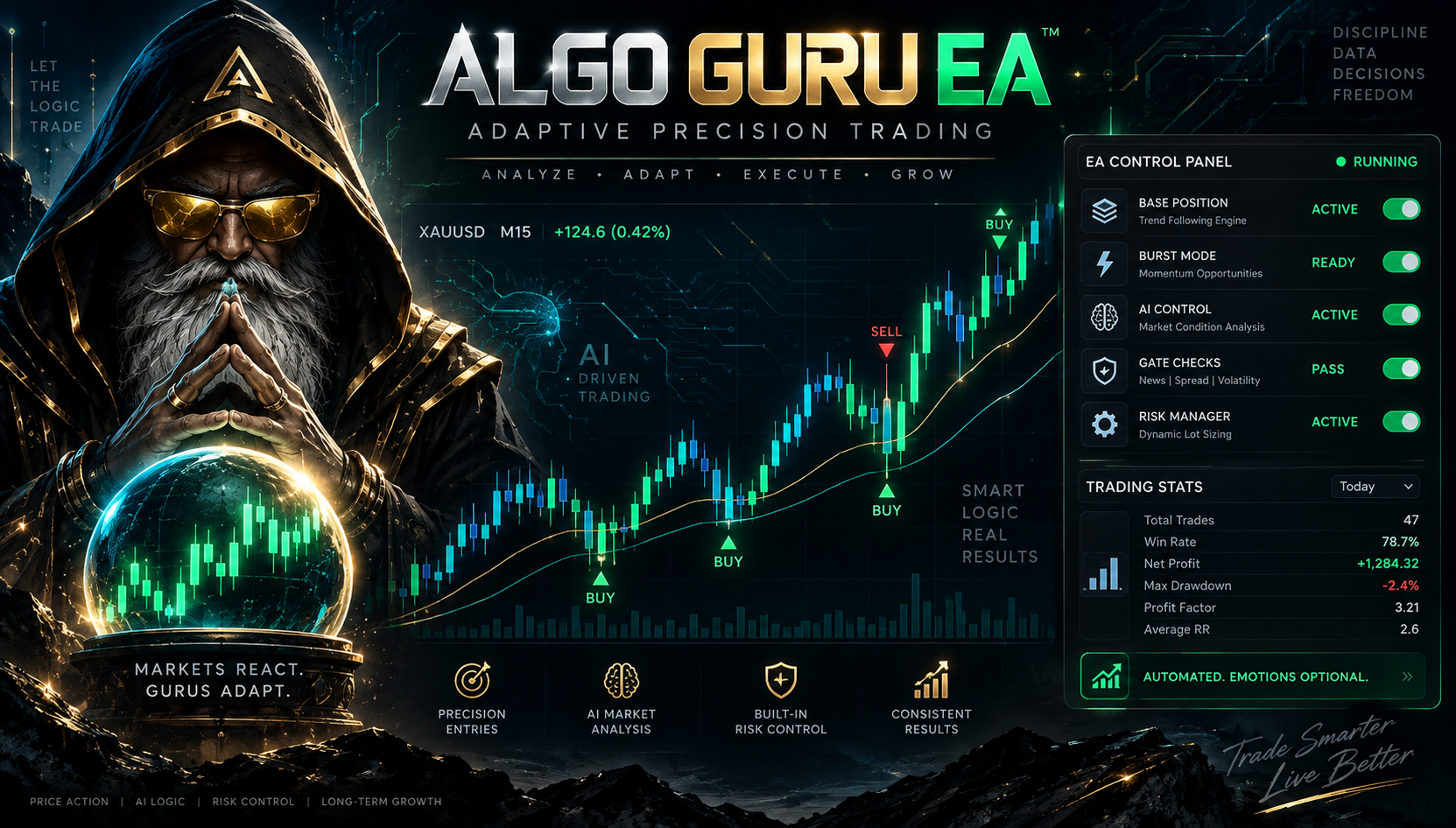
An institutional-grade algorithmic trading system for MetaTrader 5, combining a continuous Live Pressure Base engine with a high-frequency Burst recovery system, validated by the adaptive 'House of Honour' AI probability engine.

🚀 Free Quantitative Trading Edge

Get Our Weekly Strategy Audits & MT5 Indicators

Join 5,000+ traders receiving verified algorithmic backtests, Fair Value Gap (FVG) updates, and quantitative market insights straight to their inbox.

Zero spam. Actionable algorithmic setups only. Unsubscribe anytime.
FXSnipers Team

Written by FXSnipers Team

The FXSnipers Team is a dedicated group of professional traders and quantitative developers. With years of experience building high-performance Expert Advisors, automated systems, and robust risk management strategies for MT4 and MT5, they share deep market insights to help retail traders automate their success.

EDITORIAL & RESEARCH

Recommended Articles & Contributor Research

Explore complementary algorithmic guides, EA setups, and market strategies from our verified authors.

Author & Contributor Program

Publish Your Forex & Algorithmic Trading Articles On FXSnipers

Reach over 25,000+ active traders and quants. Get verified author bylines, do-follow exposure, and build direct industry authority in automated trading.

Exclusive Trader Kit 2026

Forex EA & Risk Management Cheat Sheet

Download the complete quantitative guide: Position Sizing Formulas, Prop Firm Drawdown Rules, and MQL5 Parameter Cheat Sheets.

Instant PDF Access No Spam Guarantee