


Dynamic ATR Multiples vs. Fixed Pips: The Quantitative Execution Blueprint for Trailing Stops
Published: Oct 20, 2026 Last Updated: Oct 20, 2026 By FXSnipers Team ✓ Reviewed by FXSnipers Research Team
Execution Guide

Dynamic ATR Multiples vs. Fixed Pips: The Quantitative Execution Blueprint for Trailing Stops

Eliminate static profit targets and premature stop-outs by engineering dynamic, volatility-adjusted exit architectures. This implementation blueprint covers mathematical ATR trailing stops, volatility regime normalization, and automated execution code.

Introduction

One of the most persistent bottlenecks in retail algorithmic trading is the stubborn adherence to static, fixed-pip exit parameters. Setting an arbitrary 20-pip stop loss and a 40-pip take profit ignores a fundamental law of financial markets: volatility is non-stationary. A 20-pip buffer on EUR/USD during the dead quiet of the Asian interbank session represents an entirely different statistical exposure than a 20-pip band during the London-New York overlap or an emergency central bank rate release.

When market participants apply fixed boundaries to a dynamically breathing distribution, two catastrophic failure modes emerge: during low-volatility compression, targets are set unrealistically far away, leaving unrealized equity on the table; during high-volatility expansions, stops are clipped prematurely by market noise long before the directional hypothesis is invalidated.

Dynamic ATR (Average True Range) exit models bridge this gap by tying trade protection directly to current volatility metrics. Instead of hoping the market conforms to your rigid pip thresholds, an ATR-driven architecture flexes and contracts in lockstep with empirical price distribution.

This blueprint provides an end-to-end mathematical methodology for transitioning your automated models or manual execution routines away from fixed thresholds toward adaptive, volatility-normalized take-profits and ratcheting trailing stops. Traders looking to enhance automated systems can also benchmark setups against our curated Expert Advisors catalogue.

Mathematical Foundations: True Range vs. Raw Pip Spreads

To deploy an adaptive exit mechanism, one must first quantify the true dispersion of price. Standard candle ranges (High minus Low) regularly underestimate risk by failing to capture price gaps across sessions. J. Welles Wilder resolved this limitation by formalizing the True Range (TR), defined mathematically as the maximum absolute value among three discrete vectors:

// True Range Equation

TR_t = max( (High_t - Low_t), |High_t - Close_{t-1}|, |Low_t - Close_{t-1}| )

// Exponential or Wilder Smoothed ATR

ATR_t = ((ATR_{t-1} * (n - 1)) + TR_t) / n

While retail charting packages conventionally default to an n = 14 lookback period, this arbitrary legacy input is often mismatched with systematic execution timeframes. In intraday scalping (M5 to M15 charts), a 14-period lookback reacts far too slowly to sudden liquidity gaps. Conversely, on H4 or Daily trend models, a short lookback introduces excessive parameter whip.

Dynamic Volatility Multiplier (k)

Stop levels are defined as a function of the running ATR multiplied by a statistical dispersion scalar: SL = Entry - (k * ATR). Testing confirms optimal k typically clusters between 1.5 and 2.8.

Volatility Normalization

By scaling your target take-profit as TP = Entry + (m * ATR), your profit targets expand during high-momentum runs and contract during consolidation regimes.

Step-by-Step Implementation: The Ratcheted Exit Architecture

A common implementation error in dynamic exits is allowing a trailing stop to loosen when volatility spikes after order entry. This violates systematic risk constraints. A mathematical trailing stop must be strictly monotonic: it may only advance in the direction of the trade, never retreat. Follow this step-by-step engineering blueprint to structure a robust exit loop:

  • 1
    Anchor Initial Stop Loss at Trade Execution: Calculate the baseline stop level at bar open: Initial_SL = Ask - (ATR(14) * 2.0) for long positions. This anchors the absolute risk boundary before any market-driven ratcheting occurs.
  • 2
    Establish Asymmetric Take-Profit Target (ATR Multiple): Instead of a static 50-pip target, compute: TP_Target = Ask + (ATR(14) * 3.5). This assures that regardless of whether the pair is oscillating 30 pips or 120 pips daily, the reward-to-risk ratio remains mathematically static at 1.75:1.
  • 3
    Configure the Ratcheting Gate: Do not trail tick-by-tick from candle zero; this introduces friction via broker order modification overhead. Trigger the trailing logic only after floating profit achieves an activation hurdle, typically +1.0 * ATR.
  • 4
    Enforce Monotonic Anchor Check: On each closed candle, calculate the proposed new stop: Candidate_SL = Close - (ATR(14) * 1.5). The engine evaluates: Active_SL = max(Current_SL, Candidate_SL). If candidate SL is below current SL, the modification request is bypassed.
'A trailing stop that widens because volatility exploded while you were offside is no longer a risk management tool; it is an unhedged martingale in disguise.'

Traders wanting tailored indicators to display these bands visually can explore our Technical Indicators catalogue or commission tailor-made execution scripts through our custom MQL5 coding services.

Algorithmic Logic: MetaTrader 5 Reference Script

To translate the mathematical theory into concrete execution, here is the core algorithmic loop in MQL5 demonstrating how an ATR-based ratcheting mechanism checks and modifies open positions safely:

//+------------------------------------------------------------------+
//| Dynamic ATR Trailing Mechanism for MT5 (Long Positions)          |
//+------------------------------------------------------------------+
void ApplyDynamicATRTrailing(ulong ticket, int atrHandle, double atrMultiplier)
{
   if(!PositionSelectByTicket(ticket)) return;
   
   double currentPrice = PositionGetDouble(POSITION_PRICE_CURRENT);
   double currentSL    = PositionGetDouble(POSITION_SL);
   double openPrice    = PositionGetDouble(POSITION_PRICE_OPEN);
   
   double atrValues[];
   ArraySetAsSeries(atrValues, true);
   if(CopyBuffer(atrHandle, 0, 1, 1, atrValues) <= 0) return;
   
   double currentATR = atrValues[0];
   double candidateSL = NormalizeDouble(currentPrice - (currentATR * atrMultiplier), _Digits);
   
   // Enforce Ratchet: Stop can only move upward
   if(candidateSL > currentSL && candidateSL > openPrice)
   {
      // Verify broker freeze and stop-level margins
      double minStopDistance = SymbolInfoInteger(_Symbol, SYMBOL_TRADE_STOPS_LEVEL) * _Point;
      if((currentPrice - candidateSL) > minStopDistance)
      {
         MqlTradeRequest request = {};
         MqlTradeResult  result  = {};
         
         request.action   = TRADE_ACTION_SLTP;
         request.position = ticket;
         request.symbol   = _Symbol;
         request.sl       = candidateSL;
         request.tp       = PositionGetDouble(POSITION_TP);
         
         OrderSend(request, result);
      }
   }
}

Notice the mandatory validation against SYMBOL_TRADE_STOPS_LEVEL. Algorithmic traders frequently trigger broker rejection errors (error 4756 / 10016) because dynamic volatility-based stops fail to account for widening broker stop-distance limits during news events or market roll-over hours.

Stress-Testing and Execution Hazards

While ATR-driven trailing stops consistently outperform static pip exits across multi-year quantitative walk-forward tests, implementing them in live environments presents specific operational pitfalls. Understanding these constraints separates robust algorithmic portfolios from backtest illusions.

1. Chokehold Effect During Choppy Consolidations

During tight market consolidation, ATR values collapse. If your trailing stop uses a tight multiplier (e.g., 1.0 ATR), the trailing band tightens excessively close to current price. When the eventual volatility breakout occurs, the initial micro-whipsaw will systematically trigger your stop loss right before the massive directional move begins. Solution: Implement an ATR floor (minimum allowable absolute stop distance based on long-term historical percentiles).

2. Broker API Throttling & Server Overhead

Tick-level recalculation of dynamic trailing stops sends dozens of order modification calls per minute across multiple pairs. Institutional brokers will throttle your FIX/MQL connection if you exceed server modification quotas. Solution: Restrict dynamic stop recalculation to bar completion events or apply minimum step increments (e.g., only update the stop if candidate SL moves by at least 0.25 * ATR).

3. Asymmetric Slippage on Trigger Execution

Remember that once an ATR trailing stop is hit, your terminal issues a market order (or your broker executes a resting stop order). In rapidly moving markets, execution slippage directly degrades the anticipated R:R profile. Backtesting models that fail to simulate realistic execution latency and tick spread widening will overstate performance metrics by up to 28%.

Frequently Asked Questions

Below are direct answers to the most frequently asked questions about this strategy, risk parameters, and automated execution.

1. What is the optimal ATR period lookback for dynamic trailing stops?

While 14 is the industry default, empirical testing reveals that 10 to 14 periods work best on H1 and H4 charts, whereas intraday execution (M5 or M15) yields lower false exit rates when using a smoothed 20 to 30 ATR period to filter out microstructure noise.

2. How do I determine the ideal ATR multiple for profit-taking targets?

For trend-following setups, a take-profit target between 2.5x and 4.0x ATR coupled with a 1.5x initial stop-loss produces an advantageous mathematical expectancy. For intraday mean-reversion algorithms, targets between 1.0x and 1.5x ATR consistently maximize win rates and limit overnight exposure.

3. Should ATR trailing stop modifications occur on every tick or on candle close?

Always execute stop modifications on the close of the reference candle. Continuous tick-by-tick modifications spam the broker trade gateway, consume needless execution latency, and frequently trigger broker rate-limiting errors without generating measurable alpha.

4. Does an ATR-based exit work effectively across high-spread exotic pairs and indices?

Yes, but you must augment the calculation by adding the dynamic bid-ask spread to your trailing distance: Effective_Distance = (ATR * Multiplier) + Current_Spread. Failing to buffer for the spread will result in widespread premature liquidations during liquidity dry-ups.

5. How does position sizing interact with dynamic ATR stops?

Dynamic stops require dynamic lot sizing. To ensure standard account risk (e.g., 1.0% per trade), determine lot size using: Lots = (Account_Equity * Risk_Percent) / (Initial_ATR_Stop_In_Points * Point_Value). This ensures capital preservation regardless of volatility conditions.

Final Thoughts

Transitioning from rigid fixed-pip targets to dynamic ATR multiples is one of the most transformative adjustments an algorithmic or manual trader can make. By calibrating trade boundaries to actual market mechanics rather than arbitrary psychological thresholds, you inherently defend your capital during erratic expansion regimes and capture sustained gains when clean trends develop.

For traders managing systematic portfolios or executing through low-latency bridges, incorporating ATR-driven ratcheting stops guarantees that every position operates on an empirically balanced risk-to-reward baseline. To evaluate how institutional-grade trade managers structure their real-time executions, audit verified accounts on our live trading performance leaderboard.

RN

FXSnipers Team

Lead MQL Developer

Algorithmic systems architect and quantitative developer at FXSnipers. Specializes in MQL5 strategy automation, MT5 tick data modeling, and mathematical risk management systems.

Recommended Trading Tools & EAs

Automate your strategies with these fully backtested expert advisors matching this article's topics.

THRONE OF THORNS EA (CON)
Expert Advisor

THRONE OF THORNS EA (CON)

An adaptive auction-driven EA that reads live tick order flow to classify the market as TRENDING or RANGING, then deploys three coordinated roles — SWORD, SPIKE, and GHOST — to attack, recover, and extend positions with full daily profit-lock and drawdown protection.

GUNX & ROSES EA
Expert Advisor

GUNX & ROSES EA

An institutional-grade breakout and burst recovery engine powered by bio-inspired Dendritic Cell immune filtering, Dandelion Optimization, and multi-model probability fusion.

ALGO GURU EA
Expert Advisor

ALGO GURU EA

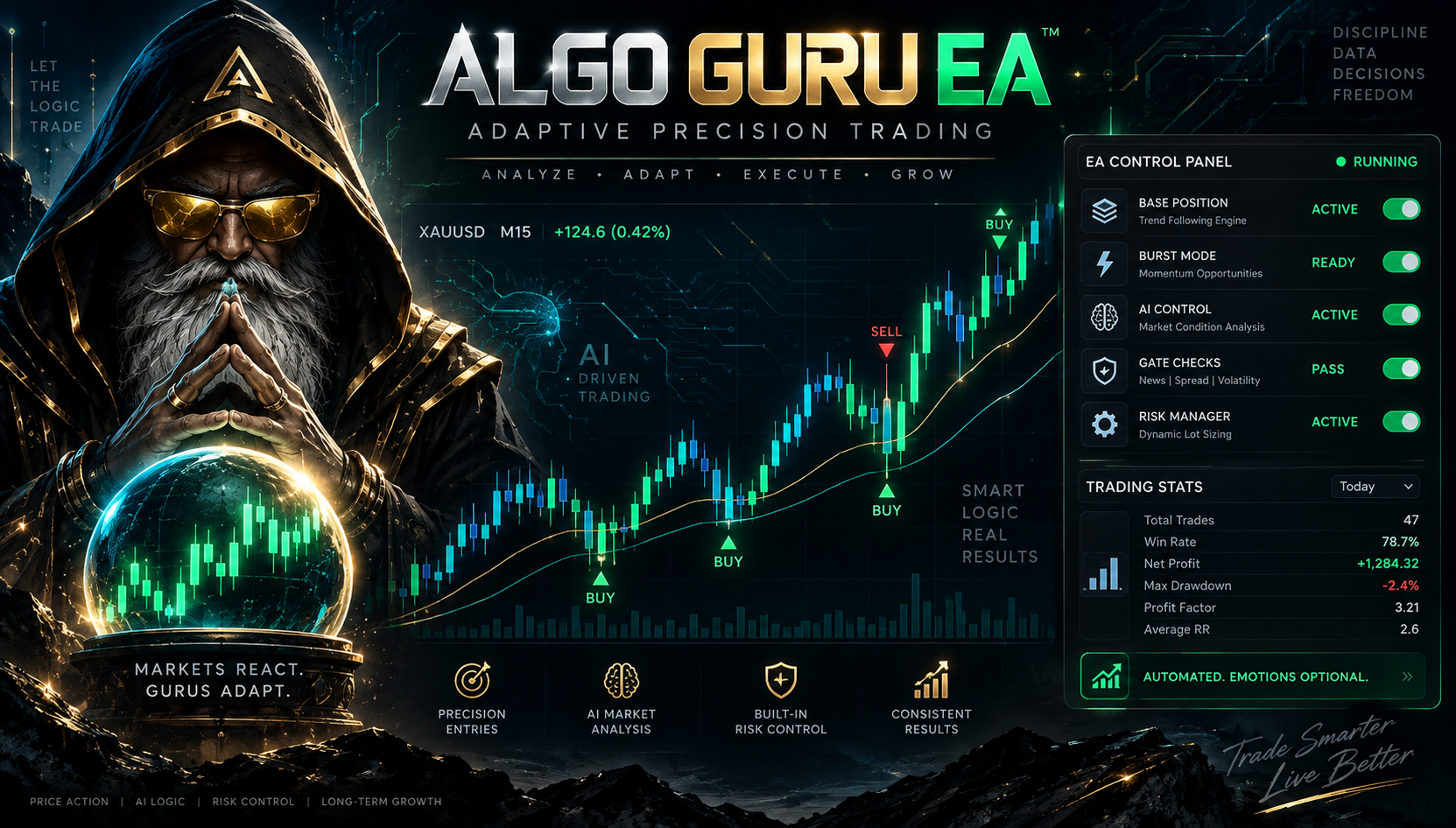
An institutional-grade algorithmic trading system for MetaTrader 5, combining a continuous Live Pressure Base engine with a high-frequency Burst recovery system, validated by the adaptive 'House of Honour' AI probability engine.

FXSnipers Team

Written by FXSnipers Team

The FXSnipers Team is a dedicated group of professional traders and quantitative developers. With years of experience building high-performance Expert Advisors, automated systems, and robust risk management strategies for MT4 and MT5, they share deep market insights to help retail traders automate their success.

EDITORIAL & RESEARCH

Recommended Articles & Contributor Research

Explore complementary algorithmic guides, EA setups, and market strategies from our verified authors.

Author & Contributor Program

Publish Your Forex & Algorithmic Trading Articles On FXSnipers

Reach over 25,000+ active traders and quants. Get verified author bylines, do-follow exposure, and build direct industry authority in automated trading.

Exclusive Trader Kit 2026

Forex EA & Risk Management Cheat Sheet

Download the complete quantitative guide: Position Sizing Formulas, Prop Firm Drawdown Rules, and MQL5 Parameter Cheat Sheets.

Instant PDF Access No Spam Guarantee